Services
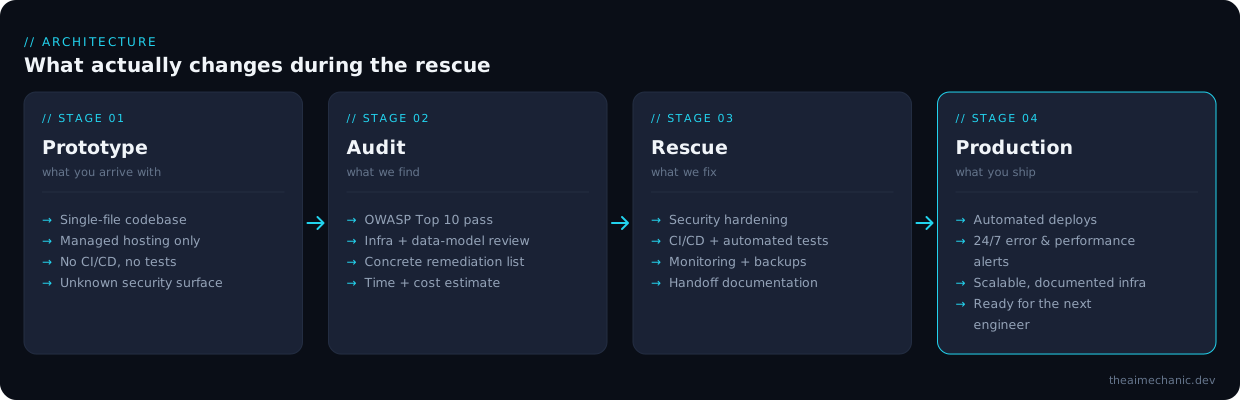
Two core services for founders with AI-built or no-code MVPs. One goal: take whatever your AI tools or no-code platform produced and get it to production — secure, scalable, and maintainable. Start with an audit. Escalate to rescue only if the audit finds what we usually find.
MVP Audit
A written technical assessment of your AI-generated or no-code MVP against production criteria — security, scalability, maintainability — sorted by business risk, not by code aesthetics. You keep the document whether you hire me for the fix or not.
AI Code Rescue
Take over an AI-generated or no-code codebase and deliver it as a real product. Fix authentication holes, broken CORS, slow databases, missing deployment infrastructure. Ship the "last 20%" AI tools skip — CI/CD, monitoring, backups, disaster recovery.
Start with the audit. Always.
Nearly every engagement that ends with a rescue starts with an audit. It's the cheapest way to find out whether a rescue is worth doing — and what it'll cost if it is. An audit is 1–2 weeks of work and produces a document you can act on, share, or walk away from. A rescue is a multi-week engagement with real scope. You don't want to buy that without a map.
A short discovery call will also tell you whether neither of these is what you need yet — sometimes the right answer is "fix your traction first" or "your stack is actually fine; here's what I'd change."
Questions founders ask before they book
Audit, always. The audit tells you whether rescue is the right next step, or whether you just have a handful of specific things to fix. I'd rather you find out you only needed two days of work than sell you an eight-week engagement you didn't need.
Yes, but only after a short scoping call. Without the audit we'd be fixing things without a map — which leads to either over-scoping (expensive for you) or missing critical issues entirely (bad for both of us). The audit is a small up-front cost that makes the rescue cheaper and better-targeted.
You still own the document. What you do next is your call. If it's a critical security issue, I'll tell you clearly and fast. If it's a mountain of smaller issues, we'll triage them together and decide which ones are actually worth fixing — not everything that's suboptimal needs fixing right now.
Two options after a rescue: hand off to your team with written documentation, or I stay on as a fractional part-time engineer for 3–6 months while you hire. I don't pitch for long-term retainers — my goal is to make myself unnecessary.
That's the specialty, but I also take rescue work on code from departed contractors, small agencies, or early in-house developers who moved on. The common thread is "nobody on the current team can read the codebase" — not specifically the tool that wrote it.
Book a discovery call
Free. 30 minutes. Tell me what the app does and what's breaking. I'll tell you honestly which service — if either — is the right next step for your situation.
Book a free call →